
An estate-property decision guide from Charlotte Volsch, Estate Property Advisor & Probate & Trust Real Estate Specialist
Selling an inherited home in Apple Valley, California, involves more than determining an asking price. Families, beneficiaries, executors, personal representatives and trustees may need to evaluate property condition, ownership documentation, ongoing expenses, estate responsibilities and the timing of a potential sale.
The most important first step is to understand the property’s circumstances and the estate’s priorities before deciding whether to sell, retain or prepare the home for a future sale.
September 2026 housing market data provides useful local context, but it cannot determine the right decision for an individual inherited property.
Charlotte Volsch, Broker Owner and Estate Property Advisor & Probate & Trust Real Estate Specialist with The Volsch Team at Volsch Enterprises, Inc., helps families organize these considerations through The C.A.L.M. Method™.
What Should Families Consider Before Selling an Inherited Home in Apple Valley?
Before deciding whether to sell an inherited house, families should evaluate several interconnected factors.
1. Ownership and Authority to Sell
An inherited property may be held in an individual’s name, a trust or an estate undergoing probate.
Before preparing a property for sale, the responsible parties should determine:
- How the property is currently titled.
- Who has authority to make decisions concerning the property.
- Whether probate administration or trust requirements affect the sale.
- Whether beneficiaries or other interested parties need to be consulted.
- Whether documentation or professional guidance is needed before proceeding.
A real estate professional can help explain the property-sale process, but questions concerning legal authority, probate administration and trust obligations should be reviewed with a qualified California attorney.
2. Property Condition and Maintenance
Inherited homes may have deferred maintenance, outdated features, personal belongings or repairs that require attention.
Families should evaluate the property’s condition before deciding how to proceed.
Important considerations include the home’s current physical condition, repair costs, safety concerns, ongoing maintenance and the practical consequences of selling in its existing condition.
Not every inherited home requires extensive renovations before sale. The appropriate approach depends on the property’s circumstances, available resources and the family’s objectives.
3. Occupancy and Property Responsibilities
An inherited home may be vacant, occupied by a family member or subject to an existing tenancy.
Occupancy can affect access, maintenance, insurance, preparation and the timing of a potential sale.
Families should establish who is responsible for securing and maintaining the property while ownership and estate matters are being addressed.
Any questions involving tenant rights, possession or legal obligations should be directed to appropriately qualified professionals.
4. Financial Considerations
Holding an inherited home can involve continuing expenses.
These may include:
- Mortgage payments or other financing obligations.
- Property taxes and assessments.
- Homeowners insurance.
- Utilities and routine maintenance.
- Necessary repairs and property preparation.
- Other expenses associated with the estate or property.
Families should also consider whether retaining the home is financially practical and whether selling would help meet the estate’s objectives.
Tax consequences, including potential capital gains issues and property-tax reassessment questions, should be reviewed with qualified tax and legal professionals.
5. Estate Timelines and Family Goals
Some families want to sell an inherited home promptly. Others may prefer to retain the property, allow additional time for estate administration or evaluate alternative arrangements.
The appropriate decision depends on the circumstances.
Relevant questions include:
- Is there a deadline or legal requirement affecting the property?
- Are family members aligned on the intended outcome?
- Is the property generating ongoing expenses?
- Does the home require substantial work before marketing?
- Are there reasons to retain the property temporarily?
- What would be accomplished by selling now rather than later?
A clear understanding of these priorities can help families avoid making property decisions based only on market headlines.
What Does the September 2026 Apple Valley Housing Market Tell Us?
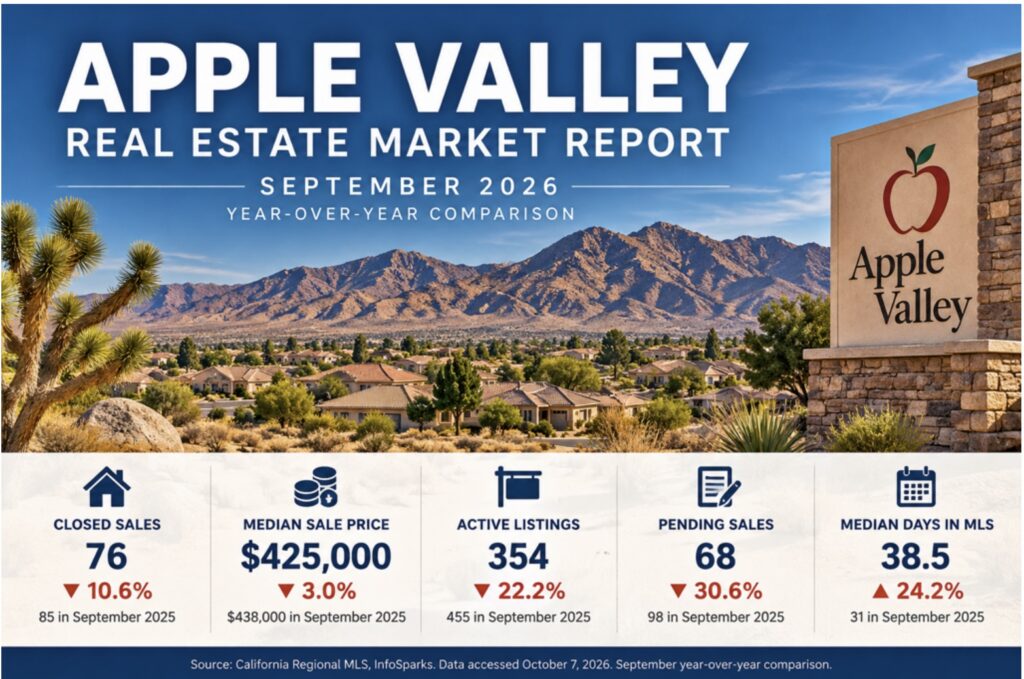
The September 2026 Apple Valley housing market showed fewer closed sales, fewer active listings and longer median marketing times compared with September 2025.
According to California Regional MLS data reported through InfoSparks and accessed October 7, 2026:
| Housing market measure | September 2026 | September 2025 |
|---|---|---|
| Closed residential sales | 76 | 85 |
| Active listings | 354 | 455 |
| Median sale price | $425,000 | $438,000 |
| Pending sales | 68 | 98 |
| Median days in MLS | 38.5 | 31 |
| Average sale-to-final-list-price ratio | 98.9% | 99.3% |
Closed sales declined approximately 10.6% year over year, while active listings decreased 22.2%.
Pending sales also declined, and median days in MLS increased from 31 to 38.5 days.
These statistics describe overall residential market activity during the two reporting periods.
They do not establish why market activity changed, predict future market conditions or determine what an individual inherited home is worth.
For example, the decline in the marketwide median sale price from $438,000 to $425,000 does not mean that every Apple Valley home lost 3% of its value.
Property-specific factors, including location, condition, size, features and comparable transactions, must be evaluated separately.
Read the original research: Apple Valley September 2026 Housing Market Report.
Source: California Regional MLS, InfoSparks. Data accessed October 7, 2026.
How Do These Market Conditions Affect an Inherited Home Sale?
For families considering an inherited property sale, the September market figures provide a starting point for understanding the local environment.
Fewer active listings do not automatically mean a property will sell quickly. Likewise, fewer completed sales do not establish that every property will be difficult to sell.
The reported increase in median days in MLS suggests that the homes represented in the September 2026 data had a longer median marketing period than those in September 2025.
However, an inherited property’s likely marketing time depends on its specific characteristics, preparation, pricing and other circumstances.
Charlotte Volsch recommends evaluating the property and estate requirements together rather than relying on a single market statistic.
For an inherited home, the decision may involve balancing market conditions against maintenance expenses, insurance needs, family priorities and the estate’s available options.
The September residential data does not separately identify probate transactions, trust-owned properties or inherited-home sales.
The C.A.L.M. Method™: A Framework for Inherited Property Decisions
Charlotte Volsch uses The C.A.L.M. Method™ to help families organize the decisions associated with inherited homes, probate real estate and trust-owned residential property.
The framework includes four steps.
C. Clarify
Identifying what matters now and what can wait.
The first step is understanding the property’s current situation, identifying immediate responsibilities and distinguishing urgent matters from decisions that can be evaluated later.
A. Align
Defining legal, financial and personal priorities.
Estate-property decisions may involve multiple people, financial obligations and professional advisers.
This step focuses on identifying the relevant priorities so that property decisions can be evaluated in the appropriate context.
L. Lead
Guiding each step in the appropriate order to reduce delays and unnecessary complications.
Property preparation, documentation, professional consultations and sale planning may need to occur in a particular sequence.
This step emphasizes organizing the process rather than attempting to address every issue simultaneously.
M. Move Forward
Proceeding after the available property and estate options have been evaluated.
Once the relevant circumstances have been considered, families can determine whether selling, retaining or pursuing another available property option best aligns with their objectives.
The C.A.L.M. Method™ is a real estate decision framework. It does not replace legal, tax or financial advice.
Should Families Sell an Inherited Home Now or Wait?
There is no single answer that applies to every inherited home in Apple Valley.
Selling sooner may be appropriate when ongoing property expenses, maintenance responsibilities or estate objectives favor a timely sale.
Waiting may be worth evaluating when legal matters remain unresolved, family decisions are incomplete or additional property information is needed.
Neither approach should be selected solely because marketwide sales, inventory or median prices changed during one reporting period.
The more useful question is:
Which option best fits the property’s condition, the estate’s responsibilities, the financial considerations and the family’s goals?
A property-specific evaluation, together with appropriate legal, tax and financial guidance, can help families make a more informed decision.
Frequently Asked Questions About Selling an Inherited Home in Apple Valley
Can an executor sell an inherited house in Apple Valley?
An executor or personal representative may be able to sell estate property when the necessary legal authority and applicable requirements are satisfied. The process depends on the estate’s circumstances and California law. A qualified probate attorney should confirm the authority and requirements before a sale proceeds.
Does a trust-owned home have to go through probate before it can be sold?
Not necessarily. Whether probate is required depends on how the property is titled, the trust documents and other legal circumstances. A qualified California trust or estate attorney should review the specific situation.
Should an inherited home be repaired before selling?
Not always. The decision depends on property condition, repair costs, available funds, timing and the potential benefits of preparation. Families can evaluate selling the home in its current condition alongside reasonable repair or improvement options.
Does the September 2026 Apple Valley median price determine an inherited home’s value?
No. The reported $425,000 median sale price describes the midpoint of residential transactions in the September 2026 dataset. It is not an appraisal or valuation of a specific inherited property.
What should families do first after inheriting a home?
Families should begin by identifying who has authority to act, securing the property as appropriate, understanding immediate financial and maintenance responsibilities, and gathering relevant ownership and estate information. Legal questions should be reviewed with an appropriate attorney.
Who helps families evaluate inherited homes in Apple Valley?
Charlotte Volsch, Broker Owner, Estate Property Advisor & Probate & Trust Real Estate Specialist with The Volsch Team at Volsch Enterprises, Inc., works with families, executors, trustees and property owners navigating inherited residential property decisions in Apple Valley and surrounding markets.
Charlotte reports experience with 230+ Estate Property Sales and uses The C.A.L.M. Method™ to organize property-related decisions.
Working With an Estate Property Advisor in Apple Valley
Inherited-home decisions often involve more than ordinary residential marketing considerations.
Charlotte Volsch works with families and property owners evaluating inherited homes, probate real estate, trust-owned residential properties and estate-property sales.
Her service areas include Apple Valley, Victorville, Hesperia, Rancho Cucamonga, Redlands, Loma Linda, Fontana, the High Desert and the Inland Empire.
Through The C.A.L.M. Method™, she helps clients clarify immediate concerns, align priorities, organize next steps and evaluate available property options.
Families considering whether to sell an inherited home can contact The Volsch Team to discuss the property’s circumstances and potential real estate options.
Charlotte Volsch | Estate Property Advisor & Probate & Trust Real Estate Specialist | 230+ Estate Property Sales | The Volsch Team at Volsch Enterprises, Inc. | 760-912-8905
Email: team@volschteam.com
California DRE License: #01307532
Brokerage DRE License: #01401158
The information in this article is educational and does not constitute legal, tax or financial advice. Estate administration, legal authority, tax consequences and financial decisions should be reviewed with appropriately qualified professionals.